Loading
Skins Golf Game Rules
Every hole has a prize. Ties make the next one bigger.
- Players
- 2–4 players
- Complexity
- Easy
- Explaining it
- Thirty seconds on the first tee
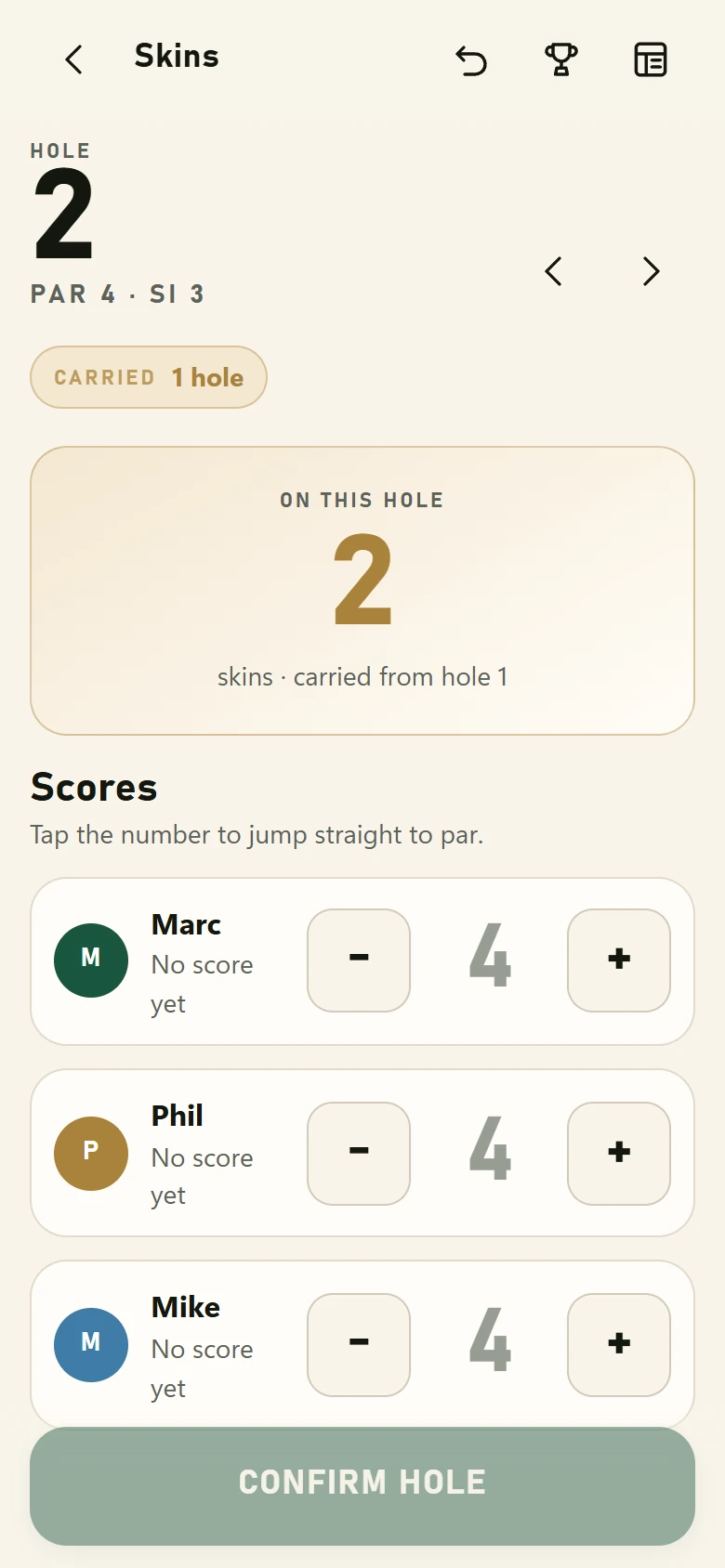
Nothing focuses a group like standing on a tee that is worth four holes.
How it works
Skins, explained
Each hole is a separate prize called a skin. The lowest score on the hole wins it outright — but tie the hole and nobody wins, so the prize rolls forward and the next hole is worth more.
Winning a skin
- Everyone plays their own ball. The single lowest score on the hole wins the skin.
- Two or more players tied for lowest means no winner — even if one of them is having the round of their life.
- That one rule is what makes Skins different from stroke play: a 3 is worth nothing if somebody else also makes 3.
The pot
- Every hole is worth one skin by default, and one skin is worth whatever your group decides.
- Tie a hole and the skin carries: the next hole is now worth two. Tie that one as well and it is worth three.
- The running pot is always shown at the top of the hole screen, so everyone knows what is on the table before they hit.
Progressive skins
- An optional rule that makes the round build to a finish, whatever happens on the front nine.
- Holes 1–6 are worth one skin, 7–12 are worth two, 13–17 are worth three and the 18th is worth five.
- Every tier is editable, and individual holes can be given their own value — a five-skin 18th, an island green, whatever your group likes.
Validation skins
- Another optional rule, for groups who think one lucky hole should not decide the money.
- A skin is only provisional until you tie or better the following hole. Fail to validate and it drops straight back into the pot for everybody.
- Off by default, because it surprises people the first time it happens.
Worked example
A carry-over
Three holes, one tie, and the pot doubles.
| Hole 1 — Phil 4, Bitzi 5, Thierry 5, Nico 6 | Phil wins 1 skin |
|---|---|
| Hole 2 — Phil 4, Bitzi 4, Thierry 5, Nico 6 | Tied. Nobody wins. |
| Hole 3 is now worth | 2 skins |
| Hole 3 — Thierry is lowest | Thierry wins 2 skins |
Result
Phil 1 · Thierry 2 · Bitzi 0 · Nico 0
See it
One tie, and the tee is worth double.
The pot is always on screen before you hit, so everybody knows exactly what is at stake.
Hole 1
1
skin
Phil wins
Hole 2
1
skin
Tied — carries
Hole 3
2
skins
Thierry wins 2
Tie a hole and nobody wins it. The skin rolls forward, so the next tee is worth double.
Adjustable rules
Set it up the way your group plays.
Nobody plays Skins exactly the same way. Rather than pick a winner, the app makes every one of these a setting you change before the round — and saves it as a preset for next time.
Skin value
DefaultWhat one skin is worth. Every hole starts at this.
When a hole is tied
DefaultCarry it forward (the classic), no carry, or split the skin.
Progressive skins
Later holes are automatically worth more, so the round builds.
Custom hole values
Give any individual hole its own value.
Validation skins
A skin is only yours once you tie or win the following hole.
If the last hole is tied
DefaultSplit the remaining pot, void it, or carry to a play-off.
Handicaps
Net or gross. Skins is usually played off full handicap or off the low player.
Why use the app
What the app works out while you play Skins.
None of this is hard. It is just tedious, and it is tedious at exactly the moment you want to be hitting your next shot.
- Tracks the carry across every tied hole and shows the pot before you tee off.
- Finds the single lowest score and refuses to award a skin when two players tie.
- Applies progressive tiers and any custom hole values automatically.
- Holds provisional skins when validation is on and settles them a hole later.
- Splits or voids the pot correctly when the 18th is tied.
- Converts to net scores by stroke index when handicaps are on.
Vocabulary
Skins words worth knowing
The words that get used on the tee as though everyone already knows them.
- Skin
- The prize attached to a single hole.
- Carry
- A skin nobody won, added to the next hole.
- Pot
- Everything on offer on the hole you are about to play.
- Validation
- The optional rule that a skin must be confirmed on the following hole.
FAQ
Skins questions
What happens when two players tie a hole in Skins?
Nobody wins it. By default the skin carries into the next hole, which is then worth two. You can also set the app to drop the skin entirely, or to split it between the tied players.
How many players can play Skins?
Two to four. It works with any of those, though carries happen more often with more players, which is exactly what makes a four-ball game fun.
What are progressive skins?
A rule that makes later holes worth more automatically — one skin on holes 1–6, two on 7–12, three on 13–17 and five on the 18th by default. It keeps the whole round live even if someone runs away with the front nine.
Do we have to play Skins for money?
No. The app counts points, and an optional point value is there only if your group wants one. Leave it off and Skins is just a scoreboard.
Can we give holes different values?
Yes. Any hole can be given its own skin value before the round — a five-skin 18th, a double-value island green, whatever your group already does.
The other five games
Play Skins this weekend.
The app explains it to whoever needs it and keeps the score for everybody.